Woetter.com
The Anatomy of the Battle Between Hero and Guide (Apple iPod vs. Microsoft Zune)
A behavioral analysis of Microsoft's fall and Apple's rise. Why focusing on your product destroys conversions and empowering the client generates fortunes.
- A behavioral analysis of Microsoft's fall and Apple's rise.
- Why focusing on your product destroys conversions and empowering the client generates fortunes.
To deeply understand the practical application and the financial impact of corporate narrative architecture, we must dissect one of the greatest corporate clashes in modern technology history. Theory teaches that the Egocentric Bias annihilates conversions and that brands must assume the position of the guide, not the hero. But how does this translate into billions of dollars in market capitalization? This case study will analyze the portable entertainment war of the early 2000s, where Microsoft chose technical protagonism, committing the Hero's Mistake, while Apple orchestrated a behavioral revolution by adopting the mentor posture in the iPod Case Study.
The Technological Landscape and Consumer Inertia

Before the iPod dominated cultural hegemony, the MP3 player market was fragmented and dominated by Asian brands and tech startups. Storage capacity was increasing, but usability was catastrophic. Companies competed strictly in the arena of technical data: megabytes, bitrates, supported formats, and battery life. All of them, without exception, operated under what we call the Curse of Knowledge, a cognitive flaw where the product creator assumes the consumer has the same level of knowledge and technical enthusiasm as they do.
In this narrative vacuum, Apple did not invent the MP3 format, nor was it the first to launch a portable hard drive player. The strategic genius under Steve Jobs' command upon his return was diagnosing that the technology itself was not the primary asset. The asset was the Framing Effect. Jobs understood that the customer was not buying silicon or plastics; the customer was trying to solve a deep internal problem of identity and aesthetic freedom.
The Zune and Corporate Vanity
Years after the iPod's launch, Microsoft, feeling the loss of market share, decided to step into the ring. With infinitely deep pockets, the Redmond giant launched the Zune. On paper, and to Microsoft engineers, the Zune was a superior device. It had a larger screen, Wi-Fi connectivity, and a feature called 'Squirt' that allowed sharing music between devices. Microsoft committed, on a global scale, The Hero's Mistake.
The Zune's marketing campaign was focused on the device and the company's engineering prowess. 'Welcome to the Social' was the slogan, forcing a collective behavior that required cognitive effort. Microsoft tried to position itself as the savior, bringing cutting-edge technology to topple Apple's design monopoly. The focus of the communication was on 'We' and 'Our device'. The company demanded that the customer pay attention to the specifications. The result? The market massively ignored the Zune because it violated the principle of customer-centric Conversion Architecture.
The iPod and the Transfer of Protagonism
In direct contrast, Apple's strategy for the iPod Case Study is the quintessence of applying the guide archetype. When Steve Jobs took the stage, he did not project specification charts for Toshiba's 1.8-inch hard drive, nor did he lecture on the complexities of the FireWire cable. He distilled hours of complex engineering into a single phrase that altered the trajectory of consumer culture:
'1,000 songs in your pocket.'
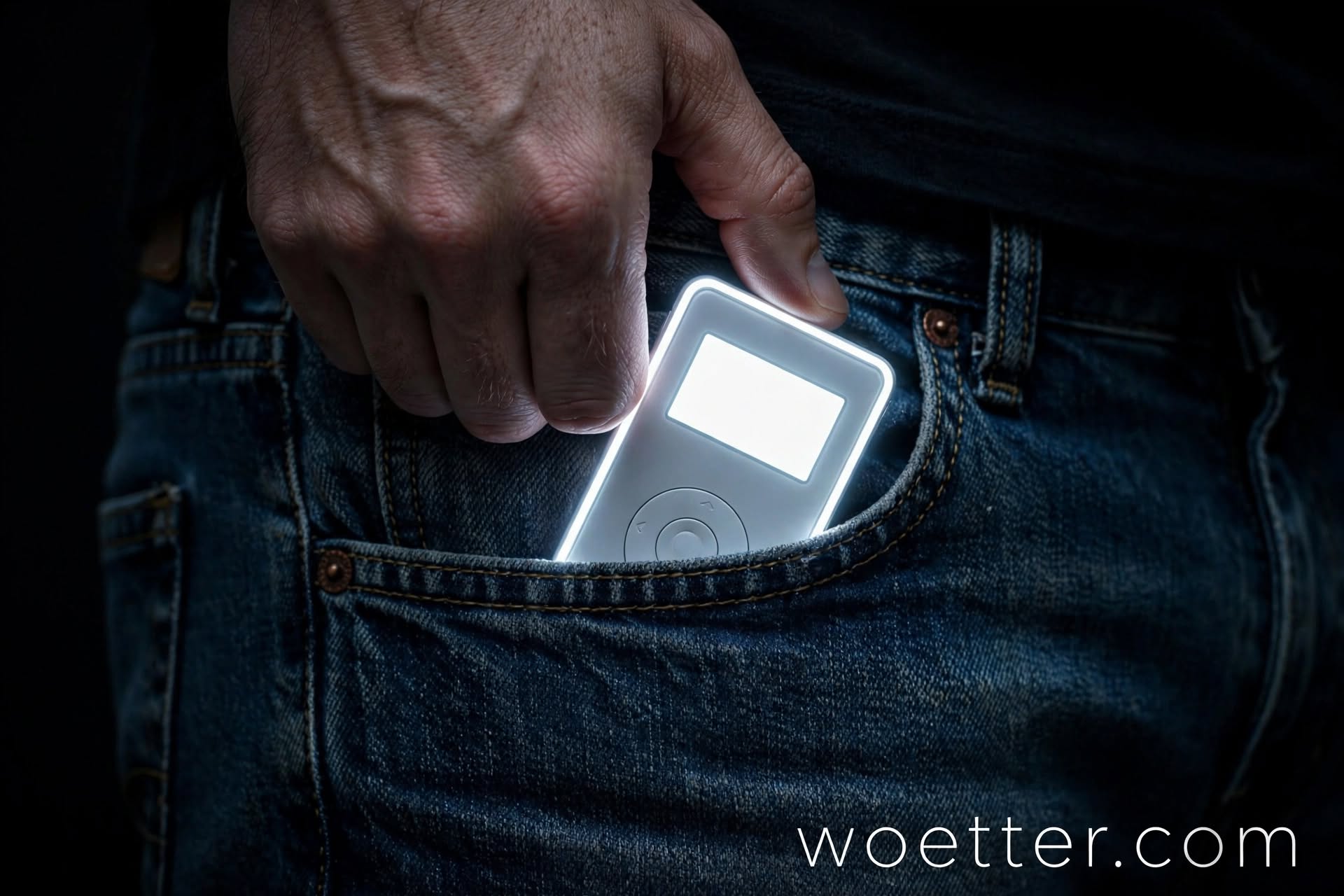
In this minimalist phrase, a profound transfer of power occurs. Apple voluntarily steps out of the spotlight and shines it on the user. Who is the hero? It is you, with your pocket and your thousand songs. Apple assumed the role of the wise guide, providing a magical tool for the user to elevate their own social status and enjoy their day's personal soundtrack.
The Behavioral Economics Behind the Gesture
Apple's victory was not merely semantic. It exploited the Endowment Effect bias, where humans value things more highly once they feel they own them. By saying 'your pocket', Apple psychologically anticipated ownership. Furthermore, the company eliminated cognitive friction. The customer didn't need to calculate how many megabytes were needed for a rock album; the promise was tangible, anchored in an emotional unit of measurement (songs) and a spatial one (the pocket).
While Microsoft sold complex features to try to impress the market, Apple sold an identity transformation. You were not just a person listening to music; you were an aesthetic rebel with the control of an entire music library at the tip of your thumb. Apple's Brand Narrative diagnosed the external problem (large and complicated CDs and MP3 players), hit the internal frustration (I want to access my music quickly and easily without feeling like an IT technician), and delivered the action plan (plug into Mac, sync with iTunes, put in pocket).
Strategic Unfoldings for the Current Landscape
What corporate leaders must extract from this epic clash is not about hardware design, but about Conversion Architecture. The defeat of the Zune and the triumph of the iPod prove that the market severely punishes corporate vanity and infinitely rewards structured empathy.
Modern companies, especially in the B2B and SaaS sectors, make the Zune mistake every day. Their landing pages are feature obituaries. They dump dashboards, API integrations, and security certifications on the front page, demanding the executive director decipher how this will help them hit targets.
To win like Apple, your business model must be invisible and your customer's transformation must be glaring. Your Brand Narrative must be surgically designed to answer the only biological question the consumer's brain is asking: 'How does this help me survive and thrive?'. If the answer to that question is a technical manual about your company's glories, you are already obsolete. Make your customer the hero and become the unforgettable guide of their journey.
Recommended Reading
- Steve Jobs by Walter Isaacson.
- Predictably Irrational by Dan Ariely.
- The Disney Way (Customer-focus applicability) by Bill Capodagli and Lynn Jackson.
Are you selling technical specs like the Zune, or selling transformative identities like the iPod? Learn to calibrate your Conversion Architecture. Subscribe to our newsletter and access confidential weekly reports on consumer behavior and elite strategies.